
We’re Having a Wile E. Moment
What happens when the systems your wealth depends on stop working as promised?
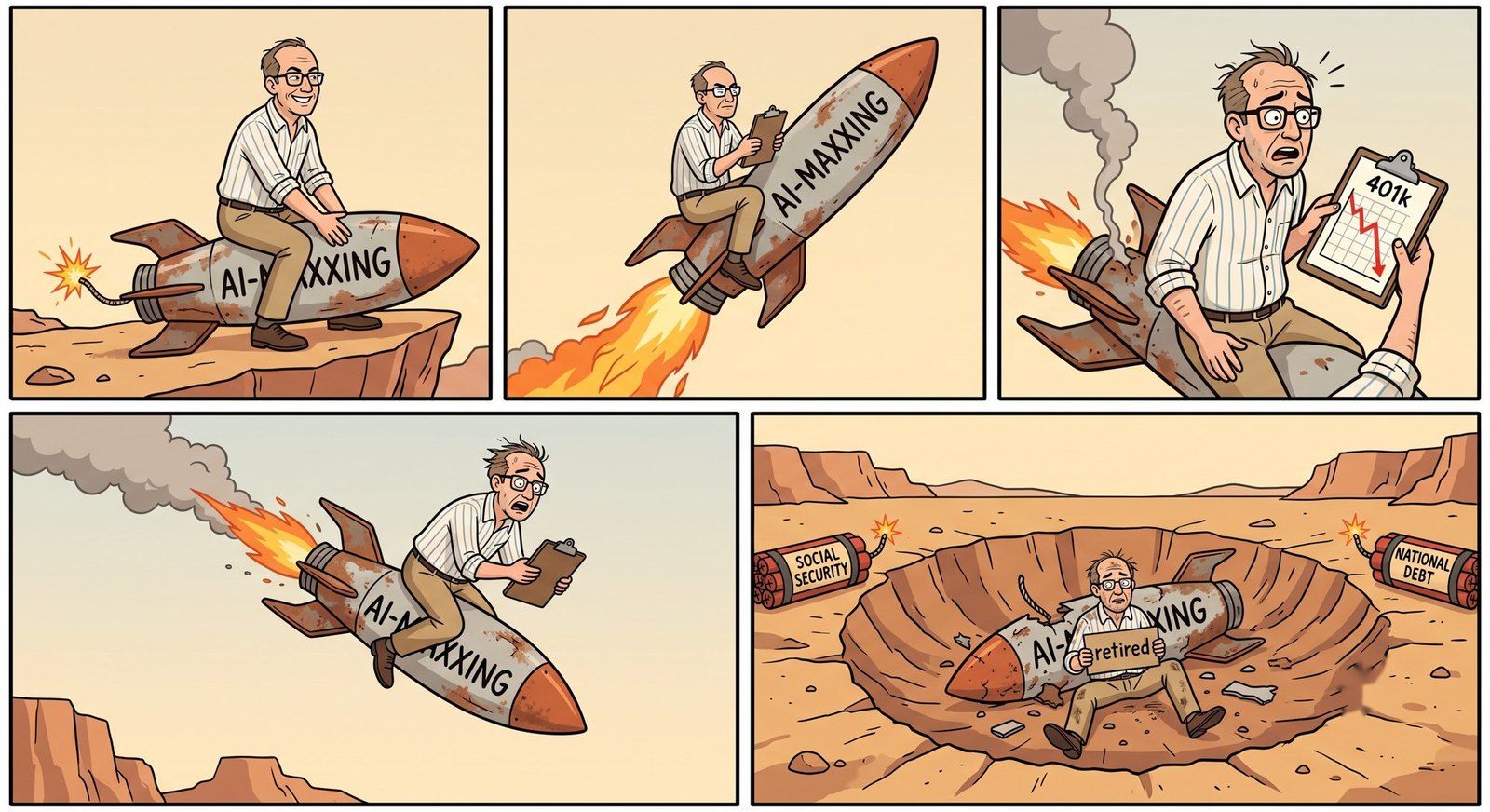
The standard advice for building household financial security has been remarkably stable for forty years. Save in tax-advantaged accounts. Hold a diversified mix of stocks and bonds. Pay down the house. Let compounding work over decades. Count on Social Security for a floor. Retire around sixty-five. For most of that stretch the playbook worked well enough that following it became a routine, like changing the oil in a car.
What’s happening now is harder to fit inside the routine. The same system that produced those outcomes now behaves in ways that weren’t advertised while we were all paying in over our careers. In 2008, U.S. household wealth fell by about $16.4 trillion. In March 2020, the S&P 500 dropped 34 percent in five weeks. Both were recovered. But recovery took years, leaned on extraordinary government intervention, and arrived too late for the households that needed their money during the downturn, not half a decade later.
Those are the visible drops. More interesting is what’s moving underneath them right now: three slower exposures that don’t show up as a dramatic single-day decline, but that quietly change the question a household should be asking about its own position.
Three exposures
Concentration. A “diversified” U.S. index fund is, in 2026, far less diversified than its name suggests. The seven largest companies — Apple, Microsoft, Nvidia, Alphabet, Amazon, Meta, and Tesla — now account for roughly a third of the S&P 500. There is no post-war precedent for that. The old record was set at the dot-com peak and broken decisively during the AI run-up of the past three years. So a retirement account sitting 70 percent in a broad-market index fund is, in practice, holding more than 20 percent of its value in seven companies whose prices assume AI keeps delivering.
Those gains aren’t vapor. The revenue is real and growing faster than any product cycle in American history; Anthropic alone went from $9 billion to over $30 billion in annualized revenue in four months. Microsoft, Google, Amazon, Meta, and Oracle are on track for roughly $700 billion in combined AI capital spending in 2026, nearly double the prior year, with Bank of America and Evercore both expecting 2027 alone to clear $1 trillion.
The tension is that spending of that scale has to be paid for. It’s funded by operating cash, an estimated $1.5 trillion in new debt over three years, and equity prices that already assume the growth continues. Each leg justifies the others in a closed loop: rising valuations justify heavier spending, heavier spending signals explosive demand, and the signal props up the valuations. The loop holds as long as revenue keeps steepening on schedule. If it doesn’t, it breaks in every direction at once — the companies issuing the debt, the ones buying the chips, and the index funds holding both.
Three things have to stay true for the trajectory to hold. AI productivity gains have to arrive fast enough to justify the spending. Displaced white-collar workers have to find equivalent pay fast enough to keep buying what these companies sell. And the wider economy has to grow fast enough to absorb both. That last one is the hard one: the Congressional Budget Office projects real GDP growth averaging 1.8 percent a year from 2027 through 2036, less than half the rate of the post-war expansions that absorbed earlier transitions. Any one of the three slipping is uncomfortable for a portfolio built on those seven names. Two slipping at once is a correction. This isn’t a forecast; it’s a note that the assumption “the market continues at its current pace” rests on conditions that aren’t guaranteed.
Watch the leading indicators. In late April 2026, reporting on internal OpenAI documents revealed the company had missed its own revenue and user-growth targets, and that its CFO had raised concerns about meeting future computing commitments if revenue didn’t accelerate. Markets moved: Oracle, which has a multi-year cloud deal with OpenAI, fell about 4 percent on the headline; SoftBank dropped 11; Nvidia, Broadcom, and AMD followed. None of those companies were in trouble that day. They were exposed to one customer’s revenue assumptions, and a single news report was enough to make the exposure visible. That’s how it tends to go in the suspended-in-air phase: the fall doesn’t come from the headline, it comes from people realizing how much was riding on assumptions that we’ve collectively chosen to ignore.
Social Security. The 2026 Trustees Report projects the combined retirement and disability trust funds run dry in 2034, after which payroll taxes alone would cover about 83 percent of scheduled benefits absent action from Congress. The retirement-only fund gets there sooner: depleted in late 2032, paying 78 percent. That’s not a partisan claim; it’s the program’s own actuarial math. Add the politics: the program was built when one large generation supported its smaller parents, and it’s now flipping to younger, smaller cohorts supporting the boomers, with Gen X caught in between. Whether the fix is benefit cuts, a higher retirement age, more taxation, or some mix, the assumption that “Social Security will look exactly like it does today when I’m ready” has weakened — and people close to retirement should adjust their assumptions accordingly.
The fiscal backdrop. Gross federal debt is now around 120 percent of GDP, the highest sustained level since World War II. The post-war drawdown was powered by a young, growing population and a globally dominant economy; those conditions don’t exist now. Interest on the debt has become one of the largest items in the federal budget, competing directly with everything else, and the population is shifting from net-contributing to net-drawing. None of this requires a crisis to matter. It simply means the responses available to the country next time are narrower than they were the last several times the system needed help.
Three exposures, all on the public record, none needing apocalyptic framing. Together they describe an environment in which the standard plan — keep contributing, keep compounding, retire on schedule — is running on assumptions that have quietly gotten more fragile than they were when you wrote the plan.
The Wile E. Coyote moment
There’s an image from the old Road Runner cartoons that captures our current state well. The coyote runs off the cliff, passes the point where the ground stops, and keeps running on air for a long beat, legs still spinning, nothing visibly wrong, until he looks down. The look down is the moment he understands where he actually is. Then gravity takes him. The fall looks sudden. It wasn’t.
The U.S. housing market in 2006 and 2007 was a Wile E. moment in real time. The Case-Shiller index rolled over in mid-2006. Subprime delinquencies climbed through the back half of the year. Bear Stearns’ mortgage funds collapsed in mid-2007. And the broad equity market still made new highs that October. The legs were still spinning. The economists later credited with calling the crisis were calling it from inside that phase, watching the indicators flash while the market kept rising. Roughly fifteen months passed between the first clear signals and the market peak, then another six between the peak and the visible failures. To the average person living through it, the fall still looked sudden.
Whether right now is that kind of phase isn’t knowable in advance. But the signals that have historically preceded big adjustments are flashing again, and the people whose job is to move capital are acting on them. Warren Buffett — not a market timer, and about as patient an allocator as American business has produced — spent his final years as CEO building the largest cash position in Berkshire Hathaway’s history, and it has kept growing under his successor: roughly $397 billion in cash and Treasuries as of the most recent quarterly filing. Berkshire has been a net seller of stocks for fourteen straight quarters, a run that included selling down what was once its largest holding, Apple. Buffett doesn’t announce his views on valuations; he reveals them through what happens to the money — and at this year’s annual meeting he warned of a “gambling mood” in markets. Right now Berkshire is doing what it has usually done near a top: building dry powder to buy the bargains that show up after the disruption.
A reasonable person looking at three structural exposures, an equity concentration with no precedent, and the most respected investor of the last sixty years parked at record defensive cash might not draw a conclusion about timing. But they might reasonably decide the assumptions under their retirement plan deserve a second look — and that the work of building more support under the household’s position is worth starting now.
Adapted from Chapter 1 of CRUX: Risk & Resilience. To see where your own household stands across ten readiness domains, the free Resilience Snapshot takes about five minutes.