
When Insurance Disappears
So does the middle class.
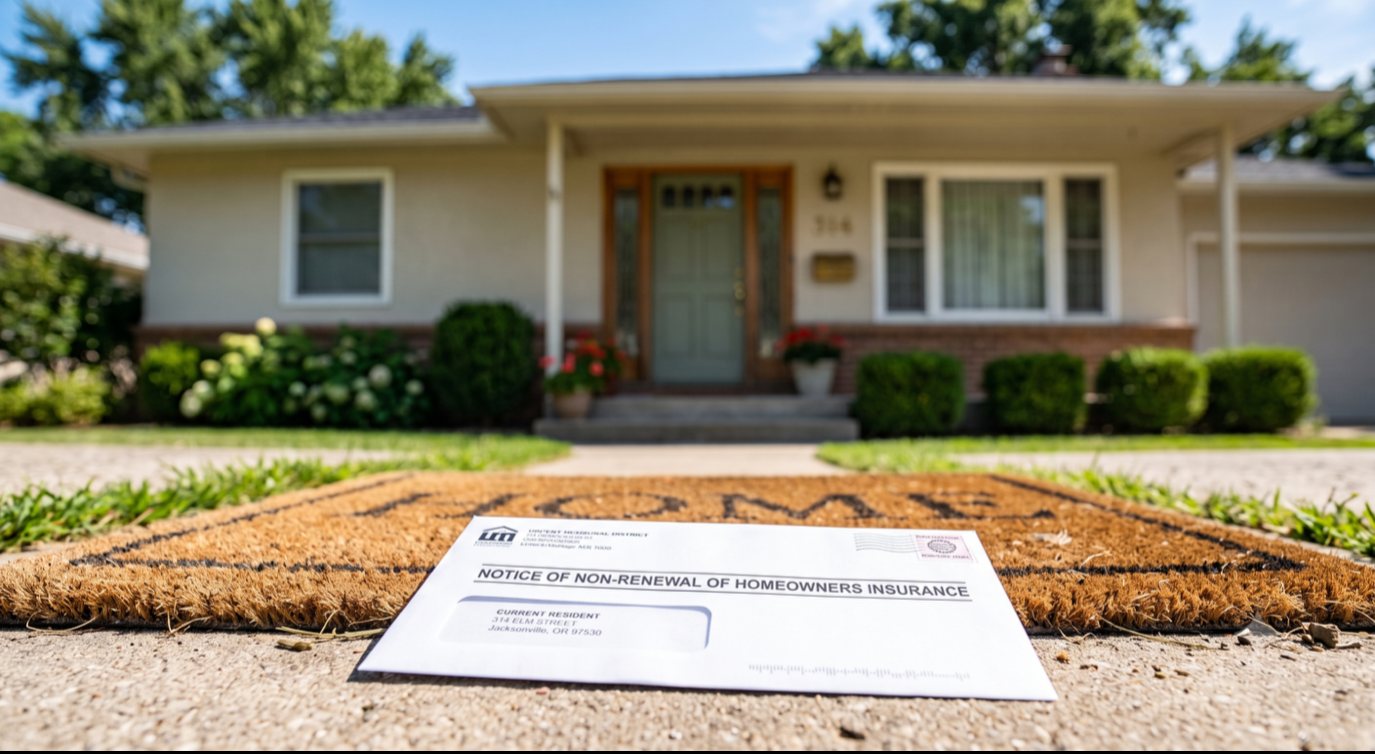
The letter that looks like a billing problem.
Somewhere in the country today, a few thousand households will open a letter from their insurer saying their coverage won’t be renewed. It reads like a billing problem, an inconvenience to be solved with a few phone calls. For a growing number of families it’s something else: the first move in a sequence that ends with the house no longer being financeable.
The retreat is spreading
This is no longer a coastal curiosity. California’s insurer of last resort, the FAIR Plan, has more than tripled since 2018 and jumped 43% in little more than a year, to roughly 670,000 policies, as insurers pulled back after the January 2025 Palisades and Eaton fires, the costliest in state history at around $40 billion in losses. Seven of the state’s twelve largest home insurers have limited or stopped writing policies since 2022. In Florida, by 2024, more than a dozen insurers had left or gone insolvent since 2020, the average premium ran near $7,500 a year, several times the national average, and 15 to 20% of homeowners carried no coverage at all. In Louisiana, premiums rose 38% in a single year.
The pattern is national. In late 2024 the Senate Budget Committee assembled the first county-level dataset of insurance non-renewals across all fifty states, drawn from companies covering about two-thirds of the market, and found the problem climbing well beyond the obvious hotspots. The Treasury Department’s insurance office maps the three big perils onto three regions: wildfire in the West, severe storms in the Midwest, hurricanes in the East. Between 2015 and 2023, the share of homeowners carrying no insurance doubled, from 5% to 12%. The forces differ by geography; the direction is the same. Insurers are repricing risk, and in the riskiest places they’re declining to carry it at all.
Backstop limits
When private insurers pull out, state plans of last resort absorb the overflow—and people assume it’s business as normal. It isn’t. A FAIR Plan holds enough reserves for an ordinary year; when catastrophe hits, it covers the gap by assessing the private insurers still operating in the state, who pass much of that cost on to their own policyholders. The backstop is funded, in the end, by everyone who still has coverage.
California is showing where the model breaks. The Eaton and Palisades fires hit the FAIR Plan with nearly $5 billion in exposure, exhausting its reserves and reinsurance. In February 2025 the state ordered a $1 billion assessment on insurers, the first since 1993, half of which can be passed through to ordinary policyholders as a surcharge. Even after that infusion the plan entered the next fire season with about $300 million on hand against $458 billion in exposure—a threefold jump since 2020—and has since sought a 36% rate increase to stay solvent. New legislation lets it borrow and issue bonds to avoid outright insolvency, but each of those tools ends the same way: higher premiums for the people still in the market.
Florida faced a different set of drivers, and the contrast is striking. Its state insurer, Citizens, ballooned to 1.4 million policies in 2023, then shrank by nearly three-quarters as the legislature curbed the lawsuit-driven claims that had made the state uninsurable and private carriers returned; it now holds a healthy surplus and filed rate cuts for 2026. Florida’s crisis was substantially a legal and fraud problem that reform could fix. California’s is a physical-risk problem, not fraud. Where the losses come from litigation, the market can heal. Where they come from fire and floods, the backstop just keeps absorbing—until someone has to pay for it.
The link
Here’s why a coverage problem becomes a wealth problem. A mortgage requires insurance. Lenders demand it to protect themselves against a borrower walking away from a ruined house, and by one estimate some $13 trillion in outstanding mortgage debt rests on that coverage. Take the insurance away and the financing goes with it. A house you can’t insure is a house the next buyer can’t finance, which shrinks the pool of buyers to those paying cash. Fewer buyers, lower prices. Federal Reserve Chair Jerome Powell put it plainly in early 2025: look out ten or fifteen years, he warned, and there will be regions where you simply can’t get a mortgage.
So the non-renewal letter isn’t really about this year’s premium. It’s a question about whether the house can be sold at all, and to whom. Insurance is the link between physical risk and financial value, and the link is giving way.
It lands on the middle
The damage isn’t distributed evenly. For households in the middle of the wealth distribution curve, their home is their wealth. The Federal Reserve’s data show the middle holds most of its net worth in real estate, while wealthier households hold theirs in stocks and business equity. Repricing the risk on homes therefore falls hardest on exactly the people whose balance sheet is mostly made up of their house.
The premium itself is regressive. When coverage runs $7,500 a year, the household that can least afford it is the one most likely to drop it, and nearly half of uninsured homeowners earn under $40,000. They are both the most exposed to disaster and the least able to absorb it. The family that stretches to keep paying is one bad year from being house-poor; the family that lets the coverage lapse is one fire or flood from losing everything. Either way, the home that was supposed to be the stable foothold becomes the fragile one.
The transfer
Here’s what happens at the bottom of the chain. It’s already visible. After the January 2025 fires destroyed roughly 16,000 homes and structures around Los Angeles, the market split in two. Homes that survived held much of their value, selling only modestly below the prior year. But properties that burned sold as vacant lots for roughly half their pre-fire worth, because the house was gone; in Altadena, land that once carried a million-dollar home changed hands in the $500,000 to $700,000 range. As a functioning market would predict, capital stepped in. A Redfin analysis found investors buying roughly 40% of the vacant lots changing hands in the fire ZIP codes, and a local tracking group put the share near 60% in Altadena. Many of the sellers, by the accounts of agents working the area, were elderly or underinsured, lacking the funds to rebuild and taking lowball cash offers because selling was the only move financially available to them.
This is the mechanism, not a metaphor. When the middle can’t hold, can’t insure, can’t finance a rebuild, can’t carry the carrying costs, the asset moves to whoever has liquidity. And liquidity has been consolidating: institutional investors went from owning fewer than a thousand single-family homes apiece before 2011 to holding some 450,000 collectively by 2022. A house slides off a household’s balance sheet and onto an investor’s, one parcel at a time. One Altadena resident who lost his home and his sister in the fire called it disaster repackaged as opportunity for the people with the most resources. The polite term is the financialization of housing. The plainer one is a transfer of wealth, and it runs in one direction.
Naming it
This isn’t only a climate story. It’s a personal-action story, and treating it as one changes what to do about it.
Some of the response is collective. California now bars unsolicited below-market offers in burn zones through 2027; a federal bill would keep large investors out of disaster areas for six months after a declaration; nonprofits in Altadena are buying lots from distressed sellers to resell to first-time buyers. Those efforts matter, and they’re worth tracking.
But the household decisions matter just as much, and they start before any letter arrives. Resilience mitigation that keeps a home insurable, hardening against the specific peril it faces, is no longer just a safety measure; it’s how you protect the asset and stay in the private market. A financial buffer is what keeps you from being the forced seller, the one who takes the lowball offer because there’s no other choice. And insurability itself belongs in the home market math now, alongside the schools and the commute, whenever anyone decides where and how to buy. Staying insurable is a fundamental goal of Crux Resilience.
The middle class largely built its wealth on a single bet: that a house is the safest thing you can own. For a widening slice of the country, that bet is quietly being repriced, and the proceeds are consolidating towards institutional investors and the very wealthy. Seeing that clearly isn’t despair. It’s the start of deciding what to do while there’s still room to decide.
Adapted and expanded from material in CRUX: Risk & Resilience. The specifics of staying insurable—peril-by-peril hardening and the financial buffer—live at cruxresilience.com; a free Resilience Snapshot takes about five minutes.
Sources
- California FAIR Plan has more than tripled since 2018 and jumped 43% in about 15 months, to ~670,000 policies, Coverage Cat: https://www.coveragecat.com/insurance-types/home/california-home-insurance-deserts
- Seven of California’s twelve largest insurers limited or withdrew since 2022; State Farm 17% emergency rate increase, State Farm newsroom: https://newsroom.statefarm.com/state-farm-in-california-understanding-the-issues/
- January 2025 Palisades and Eaton fires, costliest in California history (~$40B losses), CNN: https://www.cnn.com/2026/05/04/us/la-fires-2025-state-farm-home-insurance
- Florida the most expensive market (~$7,500/yr); more than a dozen insurers left or went insolvent since 2020, Insurance.com: https://www.insurance.com/home-and-renters-insurance/home-insurers-leaving-florida
- 15–20% of Florida homeowners now uninsured, Central Florida Public Media: https://www.cfpublic.org/housing-homelessness/2025-07-22/florida-leads-nation-in-home-insurance-non-renewal-rates
- Louisiana premiums rose 38% in a single year, Insurify: https://insurify.com/homeowners-insurance/insights/climate-risk-increasing-non-renewal-rates/
- First 50-state county-level non-renewal dataset; warning on property values, U.S. Senate Budget Committee: https://www.budget.senate.gov/chairman/newsroom/press/new-data-reveal-climate-change-driven-insurance-crisis-is-spreading
- Three main perils by region (wildfire West, severe storms Midwest, hurricanes East), U.S. Treasury Federal Insurance Office via J.P. Morgan Private Bank: https://privatebank.jpmorgan.com/nam/en/insights/markets-and-investing/ideas-and-insights/how-climate-risk-and-losses-are-creating-high-prices-for-home-insurance
- Uninsured homeowner share doubled from 5% to 12% (2015–2023); 48% of uninsured earn under $40,000, Levy Economics Institute: https://www.levyinstitute.org/publications/a-premium-crisis-climate-change-threatens-homeowners-insurance-housing-and-financial-stability/
- About $13 trillion in mortgage debt relies on insurance; Powell on future no-mortgage regions, Center for American Progress: https://www.americanprogress.org/article/managing-the-climate-change-fueled-property-insurance-crisis/
- Households in the middle of the wealth distribution hold most of their wealth in real estate, Richmond Fed: https://www.richmondfed.org/publications/research/economic_brief/2023/eb_23-39
- https://www.smdp.com/investors-snap-up-fire-zone-properties-and-housing-recovery-struggles/LA
- Investors took ~40% of burn-ZIP lot sales (Redfin), ~60% in Altadena (Altadena Not For Sale), Hoodline: https://hoodline.com/2026/03/burned-out-altadena-and-palisades-lots-become-investor-battlefield/
- Institutional investors went from under 1,000 homes each (pre-2011) to ~450,000 collectively (2022), per GAO, Dwell: https://www.dwell.com/article/corporations-buying-burned-los-angeles-properties-eaton-fire-d8029cb9
- California AB 851 and Newsom orders; Schiff federal bill on disaster-zone investor offers, Pasadena Now: https://pasadenanow.com/main/schiff-bill-would-block-big-investors-from-buying-in-disaster-zones-but-eaton-fire-properties-are-not-covered
- California FAIR Plan solvency—$1B assessment (first since 1993), ~$300M reserve entering the 2025–26 season, $458B exposure (~300% jump since 2020), 36% rate request, AB 226 bonding authority, CA Dept of Insurance (Feb 11, 2025) and Stateline (Oct 24, 2025): https://www.insurance.ca.gov/0400-news/0100-press-releases/2025/release015-2025.cfm
- Florida Citizens 1.42M policies (Oct 2023) to ~385k (end 2025), ~$5.4B surplus, no projected assessment up to a 1-in-275-year event, 2026 rate cuts; SB 2-A (Dec 2022) tort reform, Citizens 2026 Rate Kit and Artemis.bm (Mar 3, 2026): https://www.floridatrend.com/articles/2026/06/23/citizens-policy-count-hits-all-time-low/