
When Everything Burns at Once
Wildfire through the lens of resources and converging factors. Four stressed systems, and a firefighting model that assumes they don’t all fail at the same time.
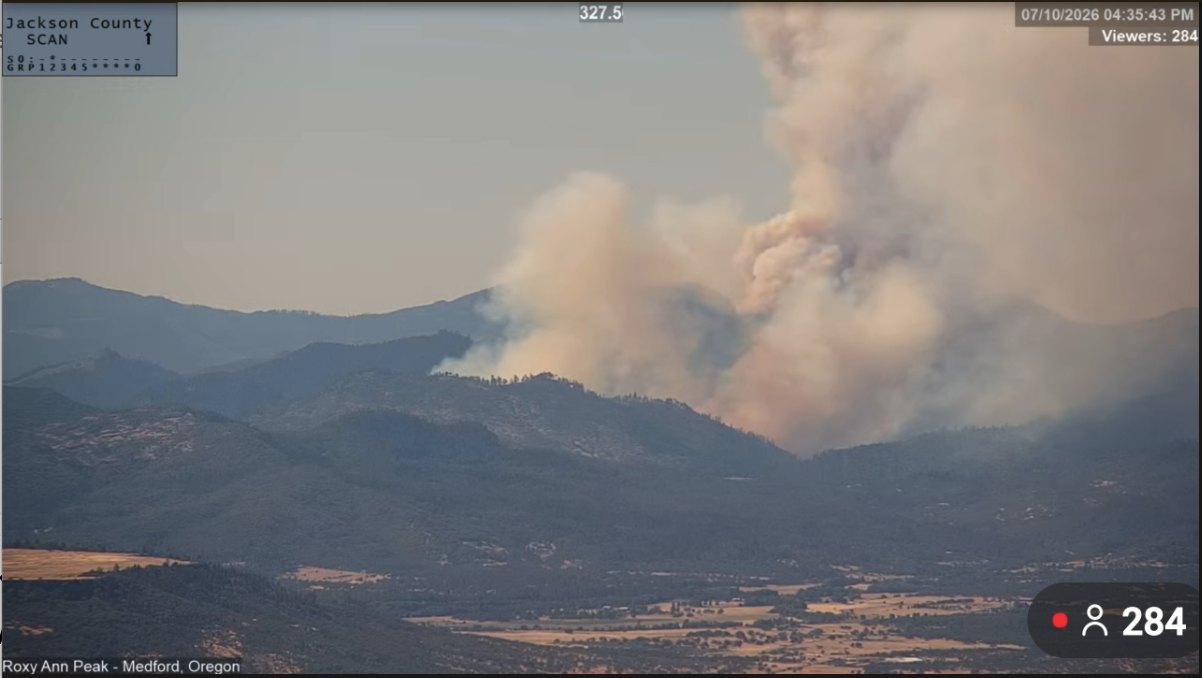
Smoke over the Rogue Valley — Jackson County fire camera, Roxy Ann Peak, Medford, Oregon, July 2026.
The way the United States fights large wildfires rests on an assumption most people never think about: that not everywhere burns at the same time.
How the model works
It’s the same assumption behind the utility line crews who show up after a hurricane. When a storm flattens the grid across the Southeast, utility trucks roll in from a dozen states that weren’t hit, because those states have slack to lend. Mutual aid works because disasters are usually local, and the unaffected can carry the affected. Wildfire suppression runs on that logic at national scale: a shared pool of crews, engines, aircraft, and overhead, dispatched to wherever conditions are worst, on the premise that there is capacity elsewhere to draw from. The National Multi-Agency Coordinating group exists to allocate exactly that, setting national Preparedness Levels from 1 to 5 to keep enough resources on hand for the next fire that starts.
The premise is sound, until too much of the country is burning at the same time. This year’s wildfire risk factors look ominous.
The factors, stacked
First, let’s look at snow. In the West snow is the summer’s water in winter storage. Snowpack supplies more than half of the region’s water, and more than 70% in mountain areas. This year it failed across the board. Eight Western states set new record-low April 1 snowpack levels: Arizona, Colorado, Idaho, Nevada, New Mexico, Oregon, Utah, and Wyoming. The lowest in the four decades since automated monitoring began; California came in second-lowest. A record-shattering March heat wave melted what little snowpack remained weeks early. Most Western states logged their warmest or second-warmest water year on record. Less snow, melting sooner, means drier fuels and a fire season that starts earlier and runs longer.
Add on to this, the state of the forests themselves. A Forest Service and Oregon Department of Forestry aerial survey found more than a million acres of dead and dying Douglas fir in Oregon, the largest die-off in the 75 years of the survey. It was severe enough that people have started calling it Firmageddon, a climate-driven mass mortality event. Persistent drought since 2019 weakened the trees and bark beetles finished them. Douglas-fir, the region’s leading commercial species, is dying across broad swathes in the Klamath Mountains. Decades of managing forests as dense commercial stands left them vulnerable. The result is millions of acres of standing dead fuel, ready to burn.
Then comes water and power demand, which are now in open conflict. On the Colorado River, system storage sits near 36% of capacity and the April-to-July runoff is forecast at roughly 13% of average. Lake Powell is projected to approach the level below which Glen Canyon Dam can no longer generate electricity. The Bureau of Reclamation is cutting releases and staging emergency transfers from upstream, while warning the move could cut Hoover Dam’s hydropower by up to 40% as soon as this fall. To prop up Lake Powell, the Upper Basin states—Colorado, Utah, Wyoming, and New Mexico—approved an emergency release of up to a million acre-feet from Flaming Gorge Reservoir through April 2027, spending down their own backup a year early. 2026 is also the first year the river’s flow past Lees Ferry is expected to fall below the level promised under the 1922 Colorado River Compact. The same drought drying the fuel is draining the reservoirs that make the power, forcing tradeoffs between water and electricity.
These aren’t four separate stories. They’re extended heat and drought periods, showing up as scarce snowpack, dead timber, and contested water, at the same time, across the same region.
The capacity gap
Now set that against the people who fight fire. Federal wildland firefighting runs on a workforce of roughly 5,700 at the Interior Department plus the Forest Service’s crews, and it is under strain from several directions at once. The Forest Service lost an estimated 1,800 fire-qualified employees in 2025 through layoffs, deferred resignations, and retirements, part of a broader loss of some 4,800 staff; operational firefighters were largely spared, but the cuts fell on the logistics, dispatch, and support roles the fireline depends on. Even after meeting its hiring number, the agency conceded the total isn’t enough capacity to meet the season’s likely demands. In 2025, Congress made the firefighters’ pay raise permanent, ending the long-running “pay cliff.” But retention stays fragile: in a March 2026 survey, roughly three in four federal wildland firefighters said they had considered quitting in the past year, and about 62% reported their units operating below full strength.
The demand side runs the other way. 2025 actually burned fewer acres than average, yet the nation still spent a near-record 59 days at Preparedness Level 4, more than double a typical year, a sign the system was stretched even in a moderate season. By mid-July 2026, more than 3.5 million acres had already burned across roughly 38,900 fires nationwide—about 157% of the ten-year average—and the nation reached Preparedness Level 4 on June 29, its earliest arrival since 2021, with more than forty large fires burning at once. A strained workforce, longer seasons, drier fuel: a convergence of demand drivers and capacity constraints straining our ability to respond to every event, every time.
Wildfire triage
When the West lights up broadly and the national pool is thin, the mutual-aid premise quietly fails. There is no slack to send, because everyone needs it at once when ‘the storm hits everywhere’. In 2022, fire managers could not fill roughly 1,800 requests for crews and 1,900 for engines. The federal government pays a premium to borrow state, local, and international resources precisely because it owns too few.
What happens then is triage. This is not just in a worst case scenario, it is standard operating procedure. When requests exceed resources, incident commanders prioritize: life safety first, then the structures that can actually be defended. A house with cleared defensible space and ember-resistant detailing is one a crew can hold without undue risk. A house ringed by fuel, with a flammable roof and open vents, is one they may have to write off, not out of indifference but because committing a crew to an indefensible structure risks the crew. The official channels, Forest Service and BLM resource orders, FEMA, state mutual aid, contract crews, all assume capacity exists somewhere to be ordered. In a ground-breakingly bad year, that assumption will be challenged.
The cavalry may not come
The practical consequence is this: in a stretched season, an engine parked at the end of your driveway is not guaranteed. And because crews triage toward what’s savable, a structure’s odds are largely set before any truck is dispatched, by work done in the months and years prior. Defensible space, an ember-resistant roof and vents, a cleared zone around the foundation, a water supply that doesn’t depend on grid power: these are not what you do when the fire is coming over the ridge. They are what determines whether your home lands on the defensible list or the written-off one while the crews are allocated to where they can make a difference. The help may not come. Plan as though it won’t.
The part you own
Most of this picture is beyond your reach. You can’t replace the snowpack, rehire the crews, or fill the Colorado River reservoirs. It’s easy to slide from denial into its quieter twin, despair—the sense that it’s all breaking and nothing you do matters. But the triage math is clear: a house is defended or written off on the strength of the direct work you do—cleared space, an ember-resistant roof and vents, water that doesn’t depend on the grid. That work is entirely yours. It is the one variable in this whole system of convergent risk factors that you control.
So do it, and treat it as more than insurance against a bad summer. A home that can stand on its own is simply a smarter way to live here, in a landscape that’s prone to burn.
Adapted and expanded from material in CRUX: Risk & Resilience. Fire mitigation projects that you can perform are at crux-works.com; the free Resilience Snapshot there takes about five minutes.